

Overview
The Create and Assign Task automation type automatically creates a new task in a specified Flow and immediately assigns it to a designated user when an automation event is triggered. This combines task creation with immediate assignment, streamlining workflows that require both actions.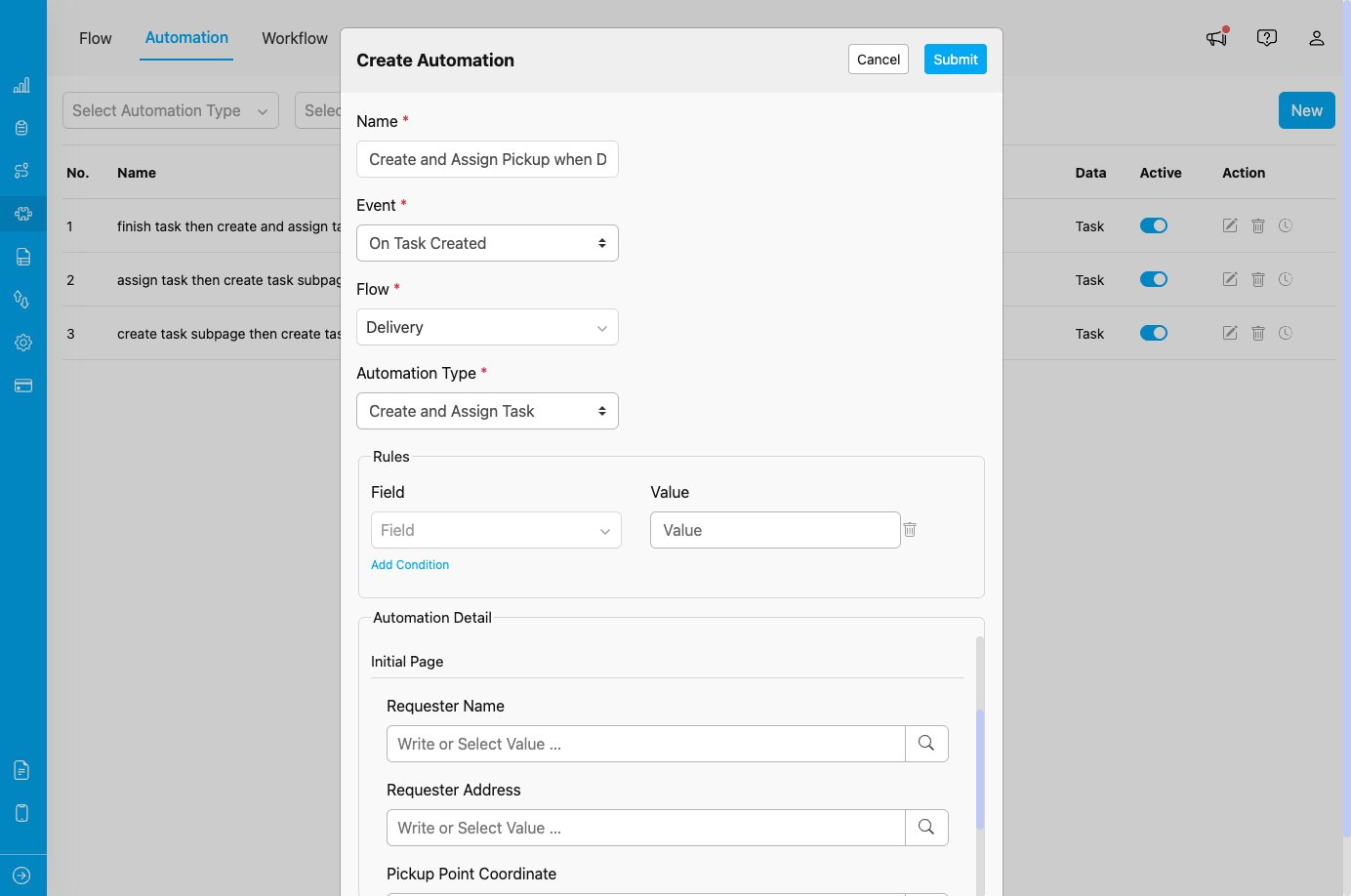
Create and Assign Task automation configuration showing Flow selection, hub assignment, field mapping, and assignee selection
When to Use Create and Assign Task
Use this automation type when you need to:- Create and immediately assign follow-up tasks to specific users
- Automatically distribute new tasks to team members based on workflow triggers
- Assign inspection or quality check tasks to designated personnel after task completion
- Create pickup tasks and assign them to specific drivers when delivery tasks are created
- Ensure new tasks are immediately assigned and don’t sit unassigned
Event Availability
Create and Assign Task automation type is available for:- On Task Created - Create and assign a new task when another task is created
- On Task Finished - Create and assign a new task when a task is completed
Configuration Fields
When you select Create and Assign Task as the automation type, you need to configure the following:1. Create Task *
Select the Flow for the new task that will be created. Purpose:- Defines which type of task will be automatically created
- Determines what fields need to be mapped
- Choose from any Flow configured in your organization
- Once selected, the Flow’s fields will appear for mapping
2. Hub *
Select the hub where the new task will be created. Options:- Follows task creator’s hub - The new task will be created in the same hub as the trigger task
- Specific hub - Select a specific hub from your organization’s hub list
- Defines the hub location for the new task
- Ensures tasks are organized in the correct operational area
3. Field Mapping (Initial Page)
After selecting the Flow, you’ll see all the fields from that Flow. For each field, you can: Option A: Manual Input- Type a static value directly into the field
- Useful for default values that don’t change
- Click the search icon next to the field
- Select a field from the trigger Flow to map its value
- The value from the trigger task will be copied to the new task
- Fields can be left empty if they are optional
- Required fields must be filled either manually or via reference
4. Assignee *
Select who will be assigned to the new task. Options: A. Auto Assign based on (Dynamic assignment from trigger task)- Assigned by - Assigns the new task to whoever created/assigned the trigger task
- Assignee - Assigns the new task to whoever is assigned to the trigger task
- Select a specific user from your organization’s user list
- The new task will always be assigned to this user
- Ensures the new task has an immediate owner
- Enables dynamic assignment based on the trigger task’s assignment
Use Cases
1. Driver-Assigned Pickup After Delivery
Scenario: Automatically create and assign a pickup task to the same driver who completed a delivery. Configuration:- Event: On Task Finished
- Flow (Trigger): Delivery
- Automation Type: Create and Assign Task
- Create Task Flow: Pickup
- Hub: Follows task creator’s hub
- Field Mapping:
- Requester Name → Customer Name (from Delivery)
- Requester Address → Customer Address (from Delivery)
- Pickup Point Coordinate → Customer Coordinate (from Delivery)
- Assignee: Assignee (auto-assign to delivery task assignee)
2. Quality Inspection Assigned to QA Team Lead
Scenario: Create an inspection task and assign it to the QA team lead when a service task is completed. Configuration:- Event: On Task Finished
- Flow (Trigger): Home Cleaning
- Automation Type: Create and Assign Task
- Create Task Flow: Quality Inspection
- Hub: QA Hub
- Field Mapping:
- Customer Name → Customer Name (from Home Cleaning)
- Service Address → Service Location (from Home Cleaning)
- Service Date → Completion Date (from Home Cleaning)
- Assignee: QA Team Lead (specific user)
3. Follow-up Task Assigned to Sales Manager
Scenario: Create and assign follow-up sales tasks to sales manager when canvassing identifies opportunities. Configuration:- Event: On Task Finished
- Flow (Trigger): Field Canvassing
- Automation Type: Create and Assign Task
- Create Task Flow: Field Sales
- Hub: Sales Hub
- Field Mapping:
- Prospect Name → Canvassed Name (from Field Canvassing)
- Prospect Contact → Contact Number (from Field Canvassing)
- Interest Level → Survey Result (from Field Canvassing)
- Assignee: Sales Manager (specific user)
4. Documentation Task Assigned to Documenter
Scenario: Create and assign documentation tasks to the documentation team lead when tasks are created. Configuration:- Event: On Task Created
- Flow (Trigger): New Customer Onboarding
- Automation Type: Create and Assign Task
- Create Task Flow: Customer Documentation
- Hub: Follows task creator’s hub
- Field Mapping:
- Customer Name → Customer Name (from Onboarding)
- Customer ID → Reference ID (from Onboarding)
- Onboarding Date → Created Date (from Onboarding)
- Assignee: Documentation Lead (specific user)
How It Works
- Event Occurs: The specified event is triggered (task created or finished)
- Rules Evaluated: If Rules are configured, they are checked against the triggering data
- Automation Triggers: The Create and Assign Task automation is activated
- Task Created: A new task is created in the specified Flow
- Fields Populated: Fields are filled with mapped values (references or static text)
- Task Assigned: The new task is immediately assigned to the designated user
- Task Ready: The new task appears in the assignee’s task list, ready for action
Field Mapping Best Practices
Understanding Field Types
When mapping fields from the trigger Flow to the new task Flow: Direct Mapping:- Map fields with similar data types (text to text, coordinate to coordinate)
- Example: Customer Name → Requester Name
- You can map any field from trigger to any field in new task
- Example: Order Number → Invoice Reference
- Use for fields that should always have the same value
- Example: Priority → “High” (always set to High)
- Required fields (marked with *) must be filled
- Optional fields can be left empty
Field Mapping Strategies
- Complete Mapping: Map all relevant fields for full context transfer
- Partial Mapping: Map only essential fields, leave others for manual input
- Hybrid Approach: Map some fields automatically, add static defaults for others
Assignment Strategies
When to Use Auto Assign
Use “Assigned by”:- When you want the task creator/assigner to handle the new task
- Example: Manager who assigns delivery should handle exceptions
- When you want the task executor to handle the new task
- Example: Driver who completes delivery should handle pickup
When to Use Specific User
Use specific user assignment:- For specialized tasks requiring specific expertise
- For tasks that should always go to the same person
- For supervisory or review tasks
Important Notes
Task Creation and Assignment Behavior
- Immediate Assignment: Tasks are assigned as soon as they are created
- Hub Assignment: Tasks are created in the specified hub (follows creator’s hub or specific hub)
- Independent Tasks: Created tasks are separate entities, not linked to trigger task
- Assignment Notifications: Assignees may receive notifications based on their notification settings
Assignment Requirements
- The assigned user must have access to the destination hub
- The assigned user must have permissions to view and edit tasks in the Flow
- If using auto-assignment, the trigger task must have the referenced user assigned
Best Practices
- Clear Flow Selection: Choose the appropriate Flow that represents the next step in your workflow.
- Meaningful Field Mapping: Map fields that provide context and reduce manual data entry.
- Use Field References: Prefer field references over manual input to ensure data consistency.
- Choose Appropriate Hub: Use “Follows task creator’s hub” for hub-agnostic workflows, or specific hub for centralized operations.
- Select Right Assignment Strategy: Use auto-assignment for dynamic workflows, specific user for specialized tasks.
- Test Thoroughly: Create test tasks to verify field mapping and assignment work correctly.
- Document Automation Purpose: Use clear automation names that describe the workflow (e.g., “Create and Assign Pickup to Driver when Delivery Finished”).
- Leverage Rules: Combine with Rules to create and assign tasks only when specific conditions are met.
- Monitor and Adjust: Regularly review created and assigned tasks to ensure automation is working as expected.
- Verify User Access: Ensure assigned users have appropriate hub access and permissions.
Troubleshooting
Issue: New task is not being created or assigned when event triggers Possible Causes:- Automation is not set to Active
- Event Flow does not match automation configuration
- Rules exclude the triggering task
- Required fields in new task Flow are not mapped
- Assigned user doesn’t exist or is inactive
- Verify automation toggle is ON
- Check Event and Flow settings match trigger
- Review Rules for conflicts
- Ensure all required fields have values (mapped or static)
- Verify assigned user is active and has appropriate permissions
- Assignee field is not configured
- Auto-assignment reference user is not assigned to trigger task
- Assigned user doesn’t have access to destination hub
- Verify Assignee field is filled in automation configuration
- For auto-assignment, ensure trigger task has the referenced user assigned
- Grant assigned user access to destination hub
- Check user permissions for the Flow
- Field reference is mapped to an empty field in trigger
- Incorrect field mapping
- Field types don’t match
- Verify trigger task has values in referenced fields
- Check field mapping configuration
- Re-map fields if necessary
- Incorrect assignee selection in automation
- Auto-assignment reference is pointing to wrong field
- Multiple automations with conflicting assignments
- Edit automation and verify assignee configuration
- Check auto-assignment reference (Assigned by vs Assignee)
- Review all active automations for the same event
- No Rules configured to filter when tasks should be created
- Multiple overlapping automation rules
- Add Rules to create tasks only when needed
- Review all active automations for the same event
- Consolidate or refine automation rules
Related Documentation
- Automation Events - On Task Created
- Automation Events - On Task Finished
- Create Task
- Assign Task
- Hub Management